
Did you always know you wanted to be an author?
I have always been creative, much to the annoyance of my parents, building forts out of sofa cushions, mixing unholy concoctions our of random kitchen ingredients, and such, and to my teachers, spending more time using up clean sheets of paper to make cartoon story books than paying attention to the lessons. Once proper reading took hold of me, I channelled that creative energy into writing tales that would just spill out of my imagination. It was more than a compulsion; it was a necessity. Before becoming a novelist, I toiled in journalism for many years, so fashioning stories is in my blood.
What is the most inspiring place you have visited and has it shown up in one of your books?
The most inspiring place, at least in relation to my writing, would be Ely Cathedral in the UK. Ely was the first great, gothic cathedral I ever met after having spent years reading about them. Words don’t to it justice. I was overwhelmed by its imposing nature rising out of the fens, which disguised a deceptively light interior, the marvel of its construction and the thrill I felt knowing that I was treading where once great men and women had trod. And when the Ely children’s choir starts singing, the place becomes magical.
While Ely Cathedral doesn’t show up in the Determined Damsels series, it is not far from Thetford, the series’ main setting, which had many small churches rather than a single big one. That said, my personal experience of visiting the cathedral (several times!) provided inspiration for the various churches, chapels, monasteries, and nunneries that do appear in the novels, as well as atmosphere and the space for interactions between characters.
What are your favorite kind of characters to write? Do you have a specific trope that you’re drawn too?
I find myself compelled to create those characters who possess talent, whether hidden or known, which they cultivate to achieve a personal ambition, protect their family, aid a friend in trouble, or impress an object of their affection. I can’t abide heroines who don’t know how to sew a button or boil an egg! Developing a talent builds confidence, instills pride and offers a means of independence for my heroines. It also gives them the confidence to tell off anyone who annoys them!
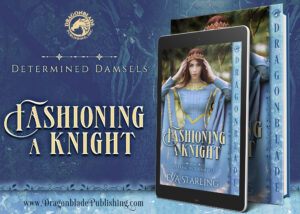
I am drawn to tropes that are a bit transgressive, so that the heroine and hero really have to work for their love, be certain of their will and desire. Crossing class barriers, mastering an unconventional trade, breaching the norms of society, challenging the laws of the church, that sort of thing. In Fashioning a Knight, as the title suggests, an untitled dressmaker and a crusader knight have a lot to deal with, considerable opposition within the respective communities, if they want to be together.
Where is your favorite place to write? Does it change depending on where you are in the process?
It’s less of a case of ‘where’ to write than ‘when.’ The conditions have to be right – the light, my mood, the sounds, the smells – which has to correspond to the scenes I’m writing. I kind of have to place myself alongside my characters. If the heroine is galloping across a field on a great, snorting steed in the heat of the day, I need to be surrounded by bright, natural light, a fresh breeze and maybe the aromas of field flowers. Conversely, if she is engaged in a tryst in a secluded garden with dusk creeping over the walls, then I prefer to pen the lines with a dimly lit, cozy atmosphere. I don’t do cosplay, but if I have to dress the part, then I will. This was particularly the case with my first novel, Fashioning a Knight, where clothing – its look, its feel, its movement – is essential to the story.
Which comes first for you: the plot or the characters?
Characters. Without question. My plots tend to be driven by the characters’ ambitions and circumstances, how they interact, how they affect others, how they force compromises and provoke epiphanies. What are they thinking when they wake up in the morning? as opposed to What’s forcing them out of bed in the morning? That said, there are always contemporary historical events in my novels that will have an impact on the characters’ decisions or views.
Do you know where the story is going before you begin, or does it come to you as you write? Do scenes come to you fully formed or are you as surprised as the reader?
I know who is getting together and who is not! That said, because my characters are driven by personal ambition and needs, they do have a target they’re always aiming at. It’s just that the direction is never straight and narrow, or the target is constantly shifting, forcing them to travel on paths they had no idea lay before them, so I find myself surprised by how they react. My novels are structured in a fair amount of detail before pen hits paper; however, I’m not so foolish as to believe that the end product will resemble the original vision. To paraphrase the German war theorist Clausewitz, “No plan survives first contact with the enemy.”
What I particularly enjoy about the writing process is how ideas will unexpectedly rise from the text, providing new insights into the characters or offering them more opportunities, forging new bonds, creating better segues between scenes, and enriching the story. It’s like planning a road trip and then discovering there is much more to see than what was suggested by the guidebook. These surprises are immensely helpful too, since I’m often not sure how character A will meet character B in a not-hopelessly-contrived manner.
From all your books, who is your favorite hero and why?
Well, I only have one book of the five in the Determined Damsels series out at the moment, but if I’m allowed to look into the future, I might give a nod to Sir William Fitzwalter the hero of Finding a Baron, which should come out later this year. Of all my heroes, Sir William is a true leader of men, not just a decorated knight or a skilled craftsman, and he understands the limits of chivalry in the real world. He might have his faults and can be brutal when needs be, but Sir William has a hard time being dishonest.
What do you like to read when you’re not reading in your genre?
I try to catch up on the classics, or what I call classics. Not so far back as Dickens or Trollope, but more recent character-driven works set in historical or a suitably exotic context, like Patricia Highsmith’s Ripley series or anything by Margaret Atwood. If the writing rocks, count me in!